Online Gratuity Calculator UAE 2026 (MOHRE Updated Tool)
Calculate Your End of Service Benefits in Seconds
Calculating your gratuity...
Ever wondered exactly how much money is waiting for you the day you walk out of your job in the UAE for the last time? Most employees have a rough idea, some don’t have a clue at all, and that gap is exactly where costly mistakes happen. Our UAE Gratuity Calculator closes that gap by turning a technical piece of labour law into a number you can see on your screen in under a minute.
Gratuity Calculator UAE: Overview
The UAE Gratuity Calculator is a free online tool built around Federal Decree-Law No. 33 of 2021, the law that governs private sector employment across Dubai, Abu Dhabi, Sharjah, and every other emirate.
It is simply a digital version of the formula written into UAE labour law. It takes your basic salary, service duration, and contract details, then applies the 21 day and 30-day gratuity rule automatically. Gratuity only applies to your basic salary, so allowances for housing, transport, and any bonuses stay out of the equation entirely.
How to Use a UAE Gratuity Calculator: Step by Step Guide
Unlike all other calculators, our gratuity calculator takes less time than making a cup of tea, provided you have your employment details ready. Really? Yes, I’m not kidding! Here’s exactly how you can do it.
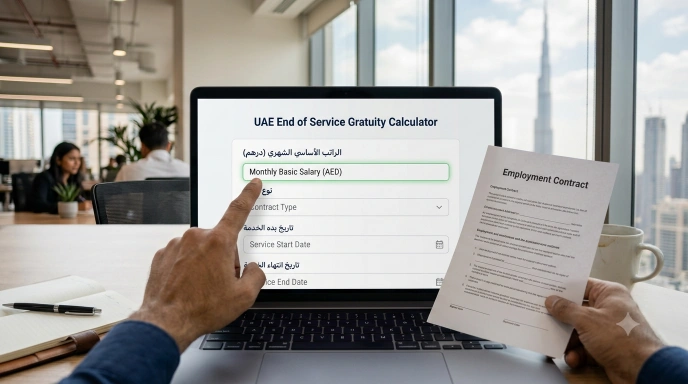
Step 1: Visit Our Website
First thing is first, in your chrome browser, type Gratuity Calculator and visit our official website. To calculate your gratuity accurately according to the UAE Labour Law, you have to enter authentic information following these steps.
Step 2: Enter Your Basic Salary
After that, add your fixed monthly figure written in your employment contract without including your total gross pay such as housing allowance, overtime, commissions, transport allowance or bonuses.
Step 3: Select Your Contract Type
From the next row, choose your contract type, limited or unlimited, since older unlimited contracts can carry legacy conditions.
Step 4: Pick your reason for leaving
The very next step is to select the reason for leaving your job from the given drop-down list. Both resignation and termination are treated differently under specific legal circumstances.
Step 5: Enter Service Duration
Now you must enter your accurate service duration from when you have started and ended. The calculator uses both dates to work out your total years and months of service.
Step 6: Hit Calculate and Review the Breakdown
Last, hit the “calculate” button and the results will be on your screen within a few seconds. You can import it to keep an official document to avoid any dispute.
UAE Gratuity Calculation Formula: The Legal Basis
Article 51 of Federal Decree-Law No. 33 of 2021 lays out the exact formula every calculator should follow. For the first five years of service, employees earn 21 days of basic salary for every year worked. Once service crosses the five-year mark, every additional year earns 30 days of basic salary instead.
Your daily wage comes from dividing your basic salary by 30. Multiply that daily figure by the eligible number of days, and you get your gratuity for that stretch of service. Partial years count too, calculated on a pro rata basis, so six months of extra service still adds real value to your final number. One thing worth remembering: total gratuity is capped at two years of basic salary, no matter how long you’ve worked for the same employer.
Eligibility Criteria for Gratuity in the UAE
Not everyone who leaves a job walks away with a gratuity payment, so it helps to know exactly where you stand.
- One year minimum: Employees who leave before completing a full year of continuous service get nothing under current law.
- Private sector focus: Government employees follow a separate pension system, while UAE nationals in the private sector can now opt into a new savings scheme.
- Unpaid leave doesn’t count: Days taken as leave without pay are excluded from your total service calculation.
- Domestic workers included: The one-year rule applies to domestic workers the same way it applies to office employees.
- Misconduct changes everything: Termination under Article 120 for serious misconduct can forfeit your gratuity entirely.
Features of a Good UAE Gratuity Calculator
Our Gratuity Calculator is an amazing tool that blends an updated legal formula with a clean, transparent interface that shows its full working. Here’s a breakdown of all its incredible features that make it a leading pick. So, let’s read on!
User-Friendly Interface
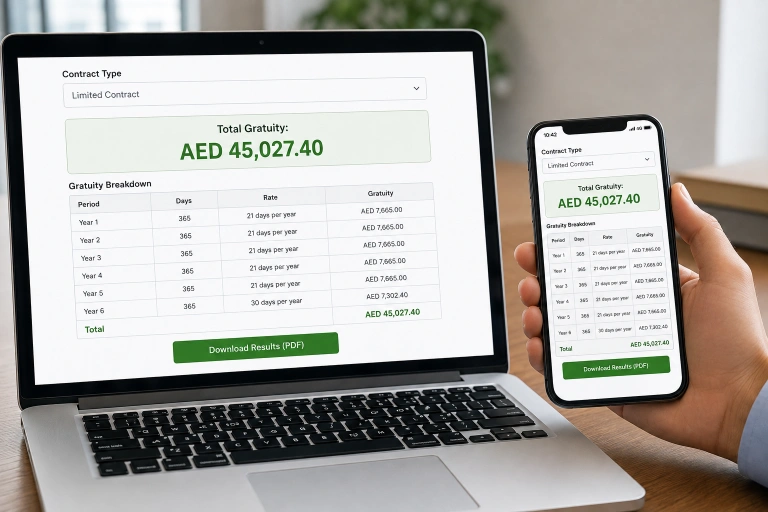
Gratuity Calculator is a tool worth trying because of its simple, easy-to-understand interface and sleek design. You can calculate the amount without putting any extra effort into it, according to UAE labour law, whether you are living in Abu Dhabi, Dubai or Sharjah.
Support for Limited and Unlimited Contracts
The cherry on top, our calculator is designed for both limited and unlimited contracts. Without being confused, you can get calculations for any of your contracts. Just select your contract and enter your data to get accurate results effortlessly.
Transparent, Detailed Breakdown
Our calculator shows your daily wage, eligible days, and a year by year split rather than dropping one lump number on the screen. That breakdown lets you manually verify the math and compare it against your employer’s final settlement letter. It builds transparency and provides a detailed breakdown that can be beneficial when any dispute occurs.
Accurate Pro-Rata Calculation
One of the most strengthening factors is that our gratuity is designed based on the U.A.E. Federal Labour Law, DDA and Free Zone Employment Regulations 2004. By entering your numbers you can get 100% accurate calculations without any extra management hassle.
Fast, Mobile-Friendly Design
How exciting is it? You can check your gratuity figure on a phone, often right before or after a resignation conversation. It is a responsive tool with minimal input fields that respects that moment instead of adding friction to it. You have no need to bother with the slow loading or clunky forms that are a red flag for reliability.
Downloadable Summary or PDF Export
Our Gratuity calculator lets you save your breakdown as a PDF for personal records or HR conversations. Having that documented estimate on hand strengthens your position if your employer’s number doesn’t match.
Gratuity Calculation-Example
Numbers make more sense with a real example attached to them, so here’s one. Imagine you are earning a basic salary of AED 10,000 and will resign after exactly 7 years of service.
- For the first five years, the formula costs 21 days per year.
- Daily wage works out to AED 333.33, calculated by dividing AED 10,000 by 30.
- Multiply that by 21 days, each year is worth AED 7,000, bringing the five-year total to AED 35,000.
- Years six and seven fall into the 30-day bracket instead.
- That’s AED 10,000 per year, adding AED 20,000 across those final two years.
- Add both totals together, and this employee walks away with AED 55,000 in gratuity after seven years of service.
What to Do If Your Employer Doesn’t Pay Your Gratuity
Our Gratuity Calculators give you a number, but what happens if your employer doesn’t deliver it? UAE law requires employers to settle gratuity and all other final dues within 14 days of the contract ending. If that deadline passes without payment, you can file a labour complaint through MOHRE, or through the relevant free zone authority. Keep every document, from your contract to your final calculator breakdown, since paperwork is what turns a dispute into a resolved case.
Contract Type: Which Rule Applies Now
Contracts in the UAE used to split into two very different categories, and each one carried its own gratuity math. Knowing which type you’re under, or were under, still matters when you’re checking an old settlement or a legacy agreement.
Limited Contract
A limited contract is a fixed-term agreement with a clear start and end date, and it’s now the standard for every new hire in the UAE since the 2023 labour reform. It’s capped at three years and renewable after that period, with no penalty attached to resigning early once you’ve completed your first year. The formula used to calculate limited contract type is given here:.
Limited Contract Formula:
Years 1-5: Gratuity = (Basic Salary ÷ 30) × 21 × Years of Service
Year 6+: Gratuity = (Basic Salary ÷ 30) × 30 × (Years of Service – 5)
Total: Gratuity (Years 1-5) + Gratuity (Year 6+)
Unlimited Contract
Unlimited contract type means no fixed end date and used to be the default option before the 2023 reform reshaped UAE employment law. Every unlimited contract that existed before the reform has now been converted into a limited agreement, so this structure no longer applies to new employees. Legacy disputes involving employees who resigned under an old unlimited contract sometimes still reference this older, tiered formula.
Unlimited Contract Formula (Legacy):
Less than 1 year: Gratuity = 0
1 to 3 years: Gratuity = (Basic Salary ÷ 30) × 21 × Years of Service × 1/3
3 to 5 years: Gratuity = (Basic Salary ÷ 30) × 21 × Years of Service × 2/3
5 years and beyond: Gratuity = (Basic Salary ÷ 30) × 21 × 5, then × 30 for each year after year 5
Resignation vs Termination: How It Changes Your Payout
Why you leave a job can shift your final gratuity number more than most employees realize. Standard resignation after one full year of service qualifies full gratuity under current law, with zero reduction penalty attached. Termination for reasons unrelated to misconduct, like redundancy or contract non-renewal, also qualifies for the same full payout.
Termination under Article 120 is the exception that changes everything. Your gratuity can be forfeited in case of any proven fraud, repeated misconduct, or a serious breach of confidentiality. If you’re facing termination and the reason feels unclear or unfair, request that documentation and verify your case with MOHRE before accepting any final number.
Free Zone Gratuity Rules: What Changes in DDA, JAFZA, and DIFC
Employees working inside a UAE free zone sometimes assume mainland labour law applies the same way, but that’s not always accurate. Free zone authorities layer their own employment regulations, and those layers can change disclaimers, dispute processes, and administrative details. The detailed breakdown is here:
Dubai Development Authority (DDA)
DDA operates under the Dubai Technology and Media Free Zone Employment Regulations 2004 alongside U.A.E. Federal Labour Law No. 33 of 2021. It runs its own official gratuity calculator for licensees and staff, and treats the result as guidance only, not a binding figure. Employment disputes involving a DDA employer route through DDA’s own Employment Dispute Request process instead of a standard MOHRE complaint.
Jebel Ali Free Zone (JAFZA)
JAFZA employees follow their own free zone employment regulations layered on Federal Decree-Law No. 33 of 2021. The core 21- and 30-day gratuity formula matches the mainland, since JAFZA does not run a separate calculation structure. Disputes and final settlement procedures route through JAFZA’s internal HR and legal affairs department. The contracts registered with JAFZA follow the standard limited contract format which was introduced after the 2023 reform.
Dubai International Financial Centre (DIFC)
DIFC operates under DIFC Employment Law No. 2 of 2019, a separate legal framework from the federal UAE Labour Law. Gratuity here is not a lump sum. Employers contribute a minimum of 5.83% of monthly basic wage into a savings plan for the first five years, rising to 8.33% after that. Legal disputes go through the DIFC Courts, not MOHRE.
A mainland calculator works for DDA and JAFZA employees, but not for DIFC, since DIFC uses a different calculation method entirely. Confirm which regulatory framework applies to your employer before finalizing any gratuity expectation.
Gratuity vs Pension vs the New UAE Savings Scheme
Gratuity isn’t the only end of service benefit UAE employees should know about, especially with newer schemes now in play.
| Feature | Gratuity | UAE Savings Scheme (Emirati Employees) |
| Who it applies to | All eligible private sector employees | UAE nationals opting in voluntarily |
| Funding source | Employer pays the full amount | Employer and employee contributions |
| Growth model | Fixed formula, no investment growth | Invested through licensed fund managers |
| Payout timing | Paid within 14 days of leaving | Structured payout based on scheme rules |
| Legal basis | Federal Decree-Law No. 33 of 2021 | Federal Decree-Law No. 57 of 2023 |
Is Gratuity Taxable in the UAE?
The UAE does not levy on your salaries or end of service benefits, so your gratuity payout arrives without any tax deduction. That’s a meaningful advantage compared to markets where gratuity or end of service payments get taxed before reaching the employee. If you are moving your funds across borders, then you must check your home country’s tax rules. UAE’s tax-free status does not automatically apply once money crosses into another jurisdiction.
Final Verdict
Summing up, being familiar with your exact gratuity entitlement puts you in control during one of the most financially important moments of any job. Our UAE Gratuity Calculator is built on the basis of Federal Decree-Law No. 33 of 2021. It gives you an accurate, instant estimate of your tax-free gratuity without any extra management hassle. Whether you’re resigning, facing termination, or simply planning, checking this number early means no surprises later.
Always compare your calculator estimate against your official final settlement letter, since small deductions or unpaid leave days can shift the actual figure slightly. If a real gap shows up between your estimate and your employer’s number, raise it with MOHRE or your free zone authority before signing anything. At the end of the day, this is your money and understanding how it’s calculated is the best protection you have.
Frequently Asked Questions
Is gratuity calculated on basic salary or gross salary in the UAE?
Gratuity is calculated only on your basic salary, and it excludes housing allowance, transport allowance, bonuses, and any other extra benefits.
Do I get gratuity if I resign before completing one year?
No, employees who leave before completing a full year of continuous service receive no gratuity under current UAE labour law.
Is there a maximum limit on gratuity payouts?
Yes, total gratuity is capped at two years of basic salary regardless of how many total years you’ve worked.
How soon must my employer pay my gratuity after I leave?
Employers are required to settle gratuity and all other final dues within 14 days of the contract ending.
Do free zone employees follow the same gratuity formula as mainland employees?
Generally, yes, though free zones like DDA, JAFZA, and DIFC add their own employment regulations alongside the federal labour law.
Is gratuity taxed in the UAE?
No, the UAE does not apply personal income tax to salaries or end of service gratuity payments.
Can my employer deduct money from my gratuity?
Yes, your employer has the authority to deduct your money from gratuity but only when they have documented legal reasons.