
Overtime Calculation in UAE: Pay Rates, Rules and Calculator (2026)
Calculating your overtime…
Your Overtime Calculation Results
Calculation Breakdown
Detailed Breakdown
Extra hours at work deserve extra pay. UAE law guarantees this.
Whether you are an employee checking your payslip or an employer running payroll, overtime calculation in UAE follows specific legal rules. Get it wrong and it costs you. Get it right and everyone is protected.
This guide covers the exact rates, step-by-step formulas, real AED examples, and what to do when things go wrong. A free calculator is also on this page to give you instant results.

What Is Overtime Under UAE Labour Law?
Overtime is any work done beyond standard hours defined by UAE law.
For private sector employees, standard hours are 8 per day or 48 per week. Any work beyond this is overtime. It must be paid at a higher rate.
Federal Decree-Law No. 33 of 2021 governs this. Article 17 sets standard working hours. Articles 20 and 21 cover overtime rates and rest day rules.
One rule applies to every overtime calculation in UAE. Always use basic salary. Never use gross salary. Housing, transport, food allowances are all excluded.
If your total package is AED 10,000 but basic salary is AED 6,000, overtime is calculated on AED 6,000 only.
Quick Reference
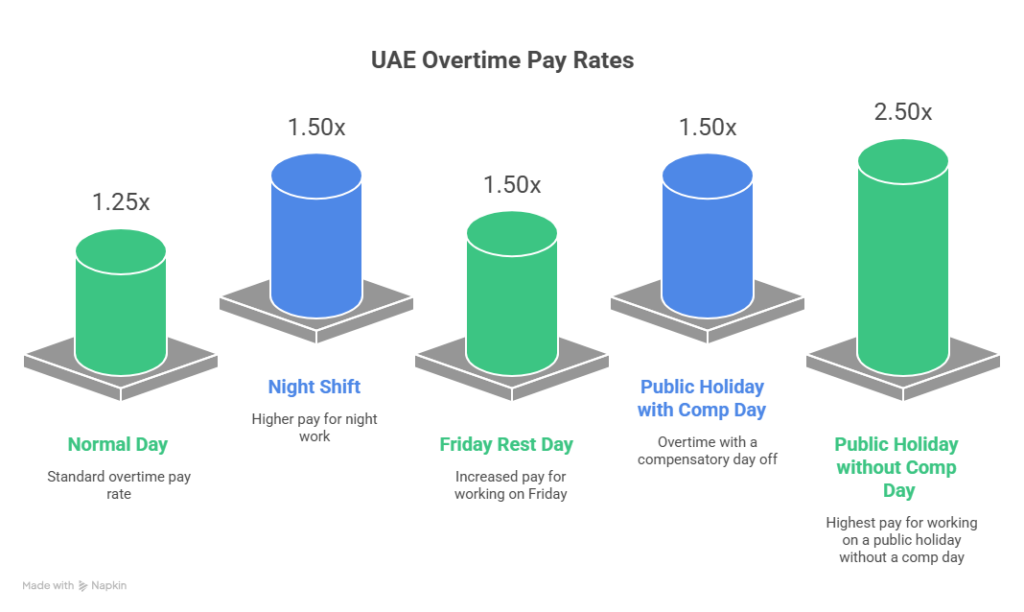
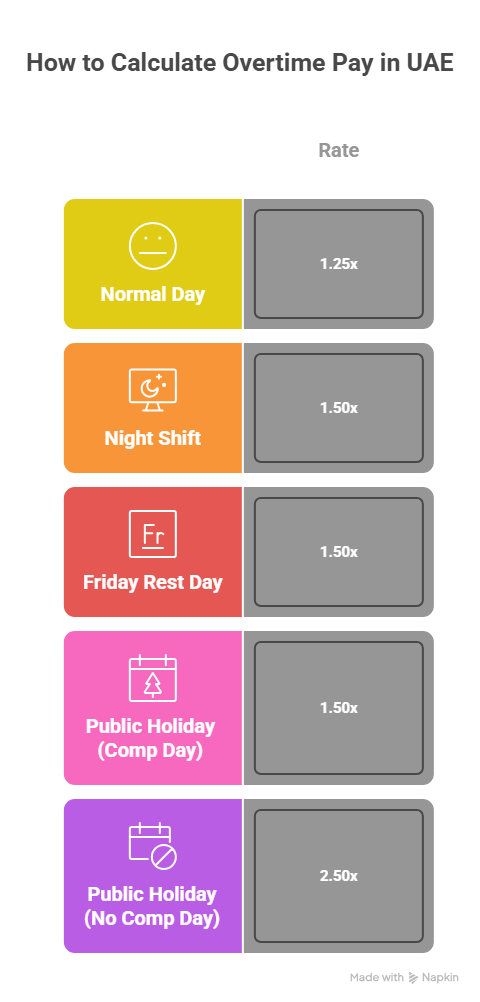
- Normal overtime: 1.25x basic hourly rate
- Night overtime 10 PM to 4 AM: 1.50x basic hourly rate
- Rest day or Friday: 1.50x plus compensatory day
- Public holiday with compensatory day: 1.50x
- Public holiday without compensatory day: 2.50x
Who Is Eligible for Overtime Pay in the UAE?
Not every employee qualifies. UAE law defines who gets overtime and who does not.
Employees Who Qualify
Most private sector workers are entitled to overtime pay. This covers office staff, technicians, sales executives, factory workers, and customer service teams.
Supervisors and team leaders also qualify. The test is simple. Do they have real authority to hire, fire, or make major decisions? If not, they get overtime regardless of their job title.
Contract workers and temporary staff qualify too. Standard UAE employment contract holders are covered.
Part-time employees qualify once they exceed their contracted hours. Overtime is calculated on their agreed hourly rate.
Employees Who Are Exempt
Article 20 of Federal Decree-Law No. 33 of 2021 lists the exemptions.
Senior executives are exempt. This includes CEOs, CFOs, CTOs, and board members. Anyone with genuine authority over company operations falls here.
Department heads with real decision-making power over budgets and hiring are also exempt. The title does not matter. The actual authority does.
Shift workers have a partial exemption. The 150% night premium does not apply to employees whose contracts require night work as a regular duty. Standard overtime still applies beyond their contracted shift hours.
Maritime workers and seafarers are fully exempt from overtime provisions.
Employees on maternity or paternity leave cannot be required to work overtime during that period.
Overtime Pay Rates in UAE
UAE law sets minimum rates for every overtime situation. Employers cannot pay less than these.
| Overtime Type | When It Applies | Rate |
|---|---|---|
| Regular overtime | Beyond 8 hours on a normal day | 1.25x |
| Night overtime | Between 10 PM and 4 AM | 1.50x |
| Rest day or Friday | Weekly day off worked | 1.50x plus comp day |
| Public holiday, comp day given | Official holiday worked | 1.50x |
| Public holiday, no comp day | Official holiday worked | 2.50x |
| Ramadan overtime | Beyond 6 hours during Ramadan | 1.25x or 1.50x night |
How to calculate overtime in UAE
Follow these three steps for every UAE overtime law. The process is the same regardless of salary level.
Step 1 — Find Your Basic Hourly Rate
Two methods are used across UAE businesses.
Method A — 30 Days
This is the MOHRE standard method. Most businesses use this.
Hourly Rate = Basic Salary divided by 30 divided by 8
Example: AED 6,000 divided by 30 divided by 8 = AED 25 per hour
Method B — Annual Formula
This method is slightly more precise.
Hourly Rate = Basic Salary multiplied by 12 divided by 365 divided by 8
Example: AED 6,000 multiplied by 12 divided by 365 divided by 8 = AED 24.66 per hour
30 days or 26 days?
Some companies divide by 26 working days instead of 30. This gives a higher hourly rate. Check your employment contract. If nothing is stated, use 30 days. That is the MOHRE default. Both methods are legally accepted but must be applied consistently.
Step 2 — Apply the Right Rate
Match your overtime type to the correct multiplier from the table above.
Overtime Hourly Rate = Basic Hourly Rate multiplied by the applicable multiplier
Normal overtime example: AED 25 multiplied by 1.25 = AED 31.25 per overtime hour
Step 3 — Multiply by Hours Worked
Total Overtime Pay = Overtime Hourly Rate multiplied by overtime hours
Example: AED 31.25 multiplied by 3 = AED 93.75
Always keep decimals throughout. Round only the final figure.
Overtime Calculation in UAE — Real AED Examples
Here are five examples covering the most common overtime situations employees and employers face in the UAE.
Example 1 — Regular Overtime
Ahmed is an accountant in Dubai. Basic salary AED 6,000. He worked 3 extra hours on a Tuesday afternoon.
Hourly rate: AED 6,000 divided by 30 divided by 8 = AED 25
Overtime rate: AED 25 multiplied by 1.25 = AED 31.25
Total: AED 31.25 multiplied by 3 = AED 93.75
Example 2 — Night Shift Overtime
Sara is a nurse in Abu Dhabi. Basic salary AED 8,000. She worked 4 extra hours between 10 PM and 2 AM.
Hourly rate: AED 8,000 divided by 30 divided by 8 = AED 33.33
Night overtime rate: AED 33.33 multiplied by 1.50 = AED 50
Total: AED 50 multiplied by 4 = AED 200
This higher rate applies because hours fall between 10 PM and 4 AM. Contracted night shift workers do not get this premium on regular shifts.
Overtime During Ramadan
Ramadan changes the working hours for everyone in the UAE private sector. This applies to Muslim and non-Muslim employees equally.
Standard hours drop from 8 to 6 per day during Ramadan. This is required under UAE Labour Law. The 2-hour reduction applies across all industries.
Any work beyond 6 hours is overtime. Normal rates apply. Daytime overtime is 1.25x. Night work between 10 PM and 4 AM is 1.50x.
Many employers forget to update their payroll systems at the start of Ramadan. The overtime threshold must change from 8 hours to 6 hours. Failing to do this means employees are underpaid every single working day of Ramadan.
DIFC has an additional rule. Muslim employees in DIFC cannot be required to work beyond 6 hours per day during Ramadan under DIFC Employment Law No. 2 of 2019.
Overtime Rules for DIFC and ADGM Employees
Federal UAE Labour Law does not apply directly to employees in DIFC or ADGM. These free zones operate under their own employment regulations.
DIFC
DIFC follows Employment Law No. 2 of 2019. Working hours are capped at 48 per week. Overtime is allowed beyond this. However, DIFC law does not prescribe the same 1.25x and 1.50x multipliers as federal law. Overtime compensation is governed by the individual employment contract.
ADGM
ADGM follows Employment Regulations 2024, effective April 2025. Written employee consent is required for overtime. Specific multipliers are not mandated. Compensation is handled through contract terms or time off in lieu.
If you work in DIFC or ADGM, your employment contract is your primary reference for overtime pay calculator free zones.
Overtime Limits Under UAE Law
UAE law caps overtime clearly. Both the daily limit and the rolling period limit apply.
Daily limit: Article 20 sets the maximum at 2 hours of overtime per day. Employers cannot require more under normal circumstances.
Three-month rolling cap: Total overtime cannot exceed 144 hours over any 3-month period. This equals roughly 48 hours per month on average.
Emergency exceptions: Genuine emergencies allow the 2-hour daily limit to be exceeded. This includes situations to prevent serious loss or accidents. Proper documentation is required.
MOHRE approval: Seasonal work or specific projects needing consistent overtime beyond normal limits require prior MOHRE approval.
Employee right to refuse: Any employee can legally refuse overtime beyond 2 hours per day. This cannot be used as grounds for disciplinary action.
What If Your Employer Does Not Pay Overtime?
This section is for employees who have worked overtime and not received correct payment.
Step 1 — Collect Your Evidence
Gather payslips, timesheets, attendance records, and any written or digital approval for overtime. Save these outside your work systems.
Step 2 — Raise It Internally
Put your complaint in writing to HR or your manager. State the dates, hours worked, and amount owed. Keep a copy.
Most overtime disputes resolve here when formally raised.
Step 3 — File a MOHRE Complaint
If the issue is not resolved internally, file a complaint with the Ministry of Human Resources and Emiratisation.
Use the MOHRE app on iOS or Android. Or go to mohre.gov.ae directly. You can also call 600 590 000.
Submit your evidence with the complaint. MOHRE will register your case and contact your employer.
Step 4 — Mediation
MOHRE will attempt to mediate between you and your employer. Most cases reach a resolution at this stage.
Step 5 — Labour Court
If mediation fails, MOHRE refers the case to the Labour Court. Legal representation is advisable at this stage.
Penalties for Non-Payment
Employers who fail to pay overtime correctly face fines of up to AED 50,000 per affected employee. Repeated violations carry further consequences including potential business license issues.
Common Overtime Calculation Mistakes in UAE
These mistakes appear regularly. Knowing them helps employees spot payslip errors and helps employers avoid fines.
| Mistake | What Goes Wrong | Correct Approach |
| Using gross salary | Allowances included in calculation base | Basic salary only from contract |
| Wrong multiplier | Night rate used as normal rate | Match hours to correct rate |
| Ignoring Ramadan threshold | Overtime starts at 8 hours during Ramadan | Update threshold to 6 hours |
| Missing compensatory leave | Holiday overtime paid without day off | Give comp day or apply 2.50x |
| Rounding mid-calculation | Early rounding creates errors | Round final figure only |
| Wrong day divisor | 26 used when contract says 30 | Check contract for correct divisor |
| Overtime on exempt staff | Manager paid overtime incorrectly | Check actual authority not title |
| No written approval | Verbal overtime only | Always get written or digital approval |
| Late payment | Overtime paid next month | Include in same payroll cycle |
| Night hours not tracked | Night premium missed | Track all hours by shift type |
Also read: Gratuity Calculator UAE
Employer Obligations for Overtime in UAE
Paying overtime correctly is one obligation. Employers also have documentation and process requirements under UAE law.
Written consent: Employees must agree to work overtime. A clause in the employment contract covering reasonable overtime is standard practice.
Accurate records: UAE law requires complete records of all overtime hours. Dates, start times, end times, and approvals must be kept. MOHRE inspectors can request these records at any time.
Timely payment: Overtime must be included in the regular monthly payroll. It cannot be deferred without employee agreement.
Clear payslips: Payslips must show overtime hours worked and the amount paid separately. This prevents disputes before they start.
WPS compliance: All salary payments including overtime must go through the Wage Protection System. Cash payments outside WPS create serious compliance risk.
Ramadan updates: Payroll systems must reflect the 6-hour daily threshold during Ramadan every year without exception.
Key Takeaways
- Overtime calculation in UAE is governed by Federal Decree-Law No. 33 of 2021
- Use basic salary only, never gross salary
- Normal overtime is 1.25x, night overtime is 1.50x, public holiday without comp day is 2.50x
- Maximum 2 hours overtime per day, 144 hours per 3 months
- Ramadan reduces standard hours to 6 per day, overtime starts after that
- DIFC and ADGM employees follow their own separate employment laws
- Non-payment of overtime can result in fines up to AED 50,000
- Use the calculator on this page for instant overtime calculation in UAE
Conclusion
Overtime calculation in UAE comes down to three things. The right salary base, the right rate, and the right hours.
For employees, these rules exist to protect you. Your overtime is a legal right. Track your hours. Check your payslip. Use the calculator on this page to verify your amount. If something is wrong, MOHRE is there to help.
For employers and HR teams, accurate calculation for overtime in UAE is not optional. It is a legal requirement. Fines reach AED 50,000 per employee. Beyond the money, unpaid overtime damages trust and increases staff turnover.
Ramadan, night shifts, public holidays, DIFC, ADGM — every situation has a specific rule. Every rule has a legal basis. This guide has covered them all.
If you are ever unsure, use the free calculator at the top of this page. Input your basic salary, your hours, and your overtime type. You will have your answer in seconds.
Fair pay protects employees. It also protects your business. That is what UAE law expects and what every workplace should deliver.
FAQ’s
Other UAE Calculators
Depending on your situation, one of these related tools may also help:
- UAE Gratuity Calculator — for standard private-sector end-of-service benefits
- JAFZA Gratuity Calculator — for employees working in the Jebel Ali Free Zone
- Domestic Worker Gratuity Calculator — for maids, nannies, drivers and other domestic staff